

Looker Software
Unlock powerful insights with Looker, the cloud-based BI platform that excels in multi-source data connectivity for real-time analytics and complex reporting.
Key Insights
Insights derived from customer feedback highlight that Looker is a cloud-based business intelligence solution favored by data analysts, finance professionals, and operations teams. Its standout feature is the ability to connect to multiple data sources, though users frequently express concerns about its limited data transformation capabilities. At Google Cloud Next’26, Looker unveiled BI Agents, introducing AI functionalities for conversational interactions and dashboard-level insights, leveraging its semantic framework.
Our Assessment
The Looker software is particularly beneficial for large organizations and data-centric teams that need to handle intricate reporting from various sources. While some users consider its pricing to be on the higher side, many believe it offers good value due to its scalability and compatibility with modern cloud infrastructures. We recommend this platform for companies that prioritize governed, real-time analytics across different business units.
What Is Looker Software?
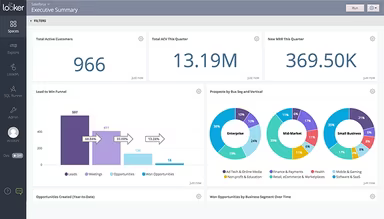
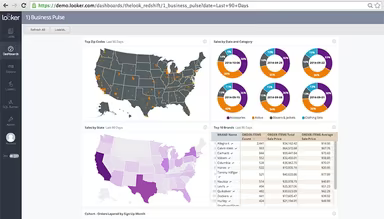
Looker software is a prominent platform for business intelligence and data analytics, created by Google Cloud. It enables organizations to convert their data into valuable insights, providing features like real-time KPI tracking, performance reporting across channels, and trend analysis within business units. This tool caters to a diverse audience, ranging from analysts to executives, and is founded on LookML, a proprietary semantic modeling language that standardizes metric definitions and queries across various teams. The platform boasts robust visualization tools, customizable dashboards, and extensive options for personalization. With the integration of Google Gemini AI into Looker, users can analyze data, create reports, and produce visualizations using natural language. Its cloud-based structure and collaborative capabilities allow users to enhance data exploration, make informed decisions, and encourage teamwork.
What is Looker Software Best For?
Looker excels in its capability to aggregate multiple data sources into a unified dashboard that updates automatically. It is particularly beneficial for data analysts, operations managers, and finance teams within medium to large enterprises, especially those utilizing Google Cloud or BigQuery as their primary data storage solution. Organizations that handle substantial volumes of recurring reports, monitor KPIs across various departments, or empower non-technical users to access data independently without developer intervention often derive significant value from this platform.
How Much Does Looker Software Cost?
The software begins at a price of $2,000 per month. Looker’s pricing structure varies according to the specific requirements of each business. The vendor provides the following plans with tailored pricing for each:
Standard
Enterprise
Embed
Apart from the initial subscription fee, organizations utilizing Looker may encounter additional costs that are not immediately apparent, including but not limited to:
Implementation And Data Modeling: Typically ranges from $3,000 to $25,000 based on the complexity of dashboards and semantic layer setup.
Data Warehouse Costs: Typically between $500 and $10,000+ per month depending on query usage and storage volume.
Custom Integrations And API Development: Generally estimated between $2,000 and $15,000 depending on the systems connected and automation requirements.
Training And User Enablement: Organizations can expect costs around $1,000 to $8,000 for onboarding analysts, administrators, and stakeholders.
Premium Support And Managed Services: Ongoing expenses are often projected at $500 to $5,000 per month based on SLA levels and consulting needs.
Many users perceive Looker’s pricing as premium; however, they often find the investment justified by its advanced features and scalability within modern cloud data environments.
Please note: Pricing references are derived from publicly accessible third-party information and industry standards. Actual costs may differ.
Looker Software Integrations
The platform seamlessly integrates with numerous third-party applications such as:
Slack Software
BigQuery
Google Analytics
How Does Looker Software Work?
Once you log in and complete the onboarding process, here is how to begin using the software:
Access the admin console to set up user roles, permissions, and controls over data access.
Open the main Looker dashboard to view essential metrics, reports, and saved explorations.
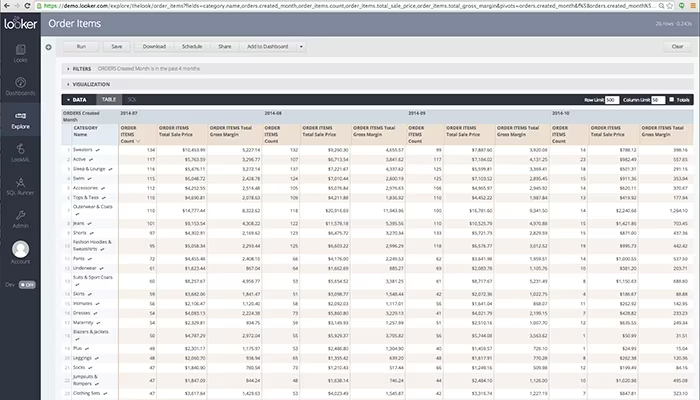
Navigating the Explore section allows you to query datasets and create custom reports using the semantic layer.
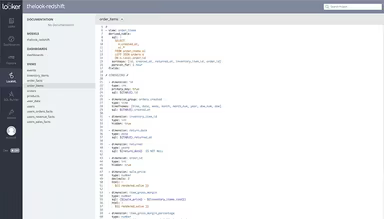
The LookML project area enables you to manage data models and define business metrics.
Create and arrange dashboards for visualizing insights across different departments and teams.
Share reports and dashboards with users according to role-based access permissions.
Schedule automated reports and alerts for ongoing business monitoring.
Incorporate embedded analytics into workflows or applications for contextual insights.
You can also schedule a complimentary demo of Looker to discover more about its functionalities.
Who Is Looker Software For?
This software is well-suited for various industries and sectors including:
Retail
Media and entertainment
Supply chain and logistics
Consumer packaged goods
Telecommunications
Financial services
Education
Healthcare and life sciences
Looker Software Use Case
An analysis of user feedback alongside Looker's current capabilities highlights key scenarios where this software aligns well with data-driven organizations, enterprises, and product-centric companies:
Enterprise Teams Centralizing Metrics Across Departments
Larger organizations with multiple business units often face challenges when finance, operations, and leadership teams work from different reports with varying definitions. This discrepancy complicates alignment on executive-level performance. The issue typically isn’t a lack of data; rather it arises when identical metrics are interpreted differently based on who created the report. In such cases, Looker could be an excellent solution for enterprise teams prioritizing standardized metric definitions over merely creating more dashboards.
SaaS Companies Embedding Analytics Into Customer Products
Product teams tasked with developing data-intensive applications often must choose between redirecting users to an external BI tool or investing considerable engineering resources in building reporting features themselves. Neither choice scales effectively; the former introduces friction while the latter diverts engineering efforts from core product development. For SaaS companies facing this dilemma, Looker's Embed edition is specifically crafted for those needing to provide interactive analytics within their applications without reconstructing their underlying data infrastructure.
Retail And E-commerce Teams Monitoring Sales And Demand Trends
Retail businesses managing both online sales and physical stores frequently struggle with fragmented data residing in separate systems such as point-of-sale systems, e-commerce platforms, and marketing tools that do not communicate effectively by default. When sales performance metrics, customer behavior insights, and channel data exist in disparate locations, it delays timely decision-making. Looker may serve retail teams dealing with this type of fragmentation well—especially when obtaining a cohesive real-time overview of performance across channels without manual data extraction is a priority.
Finance And Operations Teams Tracking Performance And Forecasting
The finance and operations teams within medium-to-large organizations often dedicate excessive time to maintaining spreadsheets while reconciling figures from various systems. They frequently find themselves recreating identical reports monthly or quarterly. This static reporting cycle creates delays between events occurring in the business and when decision-makers receive updates. Looker could be a viable option for teams aiming to shift away from this outdated method by replacing periodic manual reporting with continuously updated data models that reflect current performance without requiring constant report reconstruction.
Data Teams Standardizing Self-Service Reporting For Business Users
A growing number of organizations find their data analytics teams overwhelmed by one-off reporting requests from stakeholders who need access to information but lack technical expertise in querying it themselves. This results in backlogs that hinder both the data team’s efficiency as well as business users waiting for answers. For such teams seeking to create reusable data models that allow business users independent exploration—thus minimizing ad hoc requests while retaining control over how underlying data is defined—Looker could be an attractive option.
Is Looker Software Right For You?
If you are searching for a powerful tool for data exploration and analytics that integrates smoothly with Google Cloud products, Looker might be an excellent fit. It’s particularly beneficial for teams requiring real-time insights alongside customizable reports while providing a flexible platform that empowers both technical experts and non-technical users alike in making informed decisions seamlessly. Furthermore, this software is HIPAA-compliant while upholding several ISO and SOC security certifications which safeguard confidential user information.
If you're still uncertain whether Looker software is the right solution for your needs? Feel free to reach out at info@softwareseekers.com for further assistance.