

Tebra
Enhance your medical practice with Tebra's intuitive EHR and management platform, offering fast onboarding and efficient patient engagement tools.
Key Insights
Derived from customer feedback, Tebra stands out as a cloud-driven EHR and practice management solution tailored for small to medium-sized healthcare facilities. Users appreciate its user-friendly design and quick setup process. However, some have pointed out concerns regarding the consistency of claim processing.
Recent enhancements, such as AI-powered note assistance and automated responses for patient reviews, significantly boost the platform’s functionality and ease of use.
Our Recommendation
Tebra emerges as a dependable option for small to mid-sized medical practices in search of a comprehensive solution encompassing EHR, billing, scheduling, and patient interaction. Its user-friendly interface and rapid onboarding are particularly beneficial for new practices, while the integrated telehealth features and marketing tools foster expansion. The pricing remains competitive given its extensive offerings. We suggest Tebra for clinics that emphasize efficiency, seamless workflows, and effective patient communication.



What Is Tebra?
Tebra serves as a robust automation solution for independent practices and billing agencies. Tailored for private practices, Tebra's ‘EHR+’ platform integrates clinical workflows, billing, scheduling, and patient communication into one cohesive system.
Beyond its essential billing and Electronic Health Record (EHR) features, Tebra includes marketing tools that assist care providers in managing their online presence and reputation. These growth-oriented features enable providers to draw in and retain clients while maintaining their operations with minimal oversight.
Born from the merger of Kareo EMR and PatientPop, Tebra presents a unified platform that merges care delivery, patient engagement, and practice growth strategies. It aims to modernize every aspect of the patient journey, fostering a more interconnected and future-ready practice.
What Is Tebra Best Known For?
Tebra is primarily recognized for its all-in-one integrated platform that utilizes built-in AI to enhance administrative tasks. For example, the AI-driven note generation expedites charting processes. Additionally, Tebra’s AI facilitates automated review responses and reputation insights, enabling practices to uphold their online presence and ensure patient satisfaction effortlessly.
By automating crucial tasks ranging from appointment scheduling to claims management and payments, Tebra empowers practices and billing professionals to increase productivity, minimize manual labor, and expedite insurance reimbursements.
How Much Does Tebra Cost?
The pricing for Tebra typically falls between $99 and $399 per provider per month, according to Tebra’s guidelines on medical billing software costs as well as broader industry standards. Final costs may vary based on the number of providers, chosen modules, practice specialty, and complexity of deployment.
In addition to the standard subscription fees, practices should anticipate several additional expenses that could affect overall spending:
Onboarding: $500 per provider for setup and managed services
Implementation and setup: $1,000–$20,000
Staff training: $1,000–$5,000+
Data migration: $500–$10,000
Integration fees: $500–$3,000
Ongoing support: $500–$2,000/year
Transaction-based fees (billed monthly in arrears):
Electronic claim attachments: approximately $0.99 per document
Paper claims or patient statement mailings: around $1.10 for the first page plus additional per-page charges
Card payment processing: 2.75% + $0.30 for Tebra Payments or 2.9% + $0.30 when using Stripe integration
Optional add-ons:
Controlled substance e-prescribing: one-time setup fee of about $75
PDMP access: roughly $500 per facility plus $50 per authorized user annually
AI note generation: about $99 per provider per month for a capped subscription or $0.99 per note based on usage
When assessing Tebra’s pricing structure, buyers usually examine costs comprehensively. Initially affordable for smaller teams, total expenses can rise as onboarding, integrations, compliance requirements, and usage-based features come into play.
The pricing is subject to change.
Tebra Integrations
This platform acts as a central hub with an extensive ecosystem of integrations. It simplifies patient intake, form management, and payments through one unified interface. Tebra’s connections with over 60 EHRs and third-party platforms allow users to:
Order prescriptions, lab tests, and imaging directly from the platform
Securly share patient information without needing to switch systems
Provide virtual care with built-in telehealth capabilities without extra logins or tools required
Easily integrate with existing EHRs, including legacy systems for smoother transitions
How Does Tebra Work?
The following highlights how Tebra assists independent practices and billing agencies in focusing on what truly matters:
Automate workflows: Tebra’s certified cloud-based EHR optimizes charting, documentation, e-prescribing, and lab ordering. Features like AI-powered ‘Note Assist’, customizable templates, and shortcuts help reduce time spent on documentation.
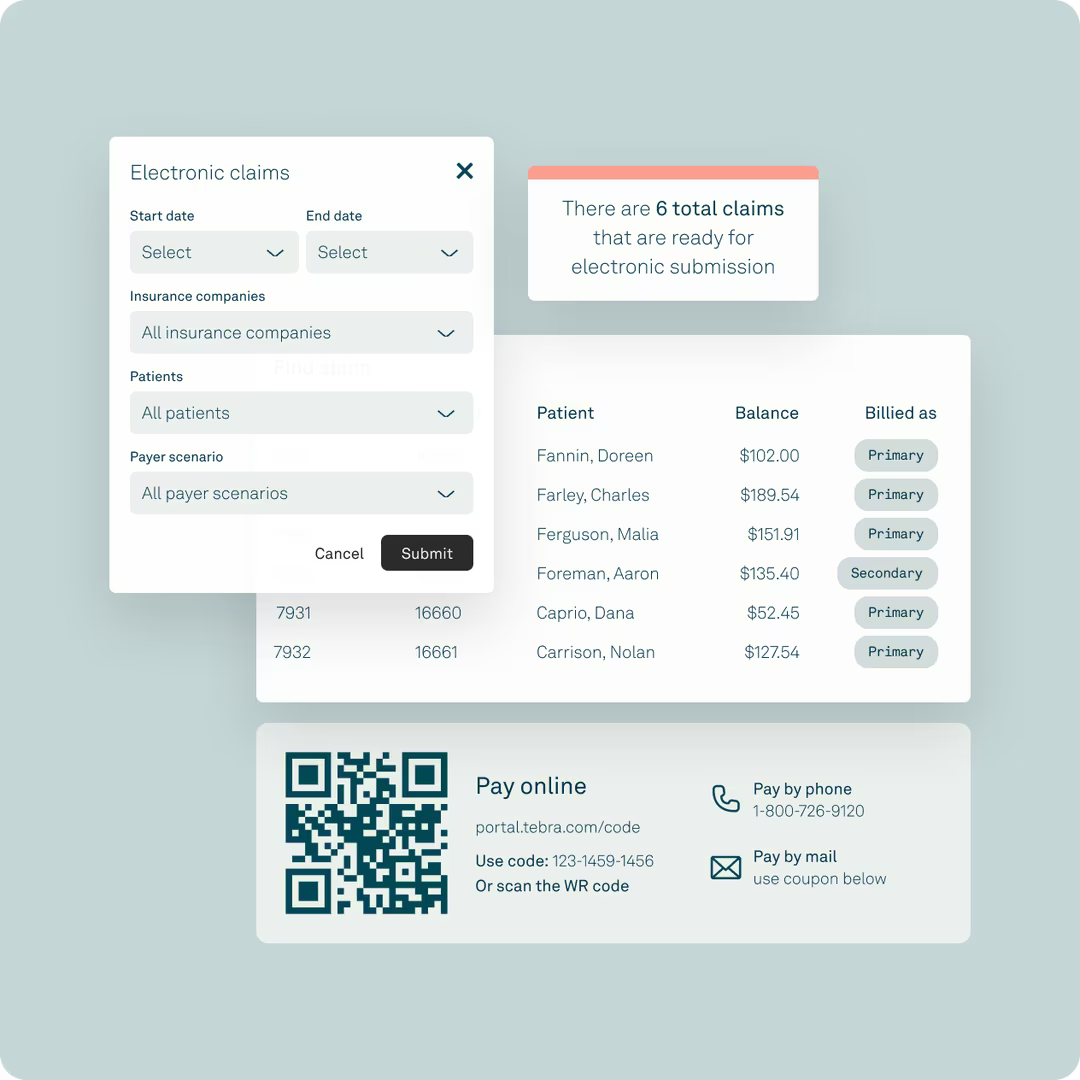
Simplify billing: Integrated billing and claims management automate charge capture, scrubbing submissions, eligibility verification, and denial management.
Create an exceptional patient experience: Tools for online scheduling, digital intake forms, HIPAA-compliant messaging, and reputation management help attract new patients while retaining existing ones.
Make informed decisions: Gain detailed insights across scheduling, billing, patient engagement, and marketing through analytics tools that track revenue trends and optimize digital presence.
Who Is Tebra For?
Tebra is designed specifically for independent medical practices, specialty clinics, and medical billing companies seeking a fully integrated cloud-native EHR+ platform. It is particularly ideal for those looking to:
Simplify their software: Practices tired of managing multiple disconnected systems for EHRs, billing processes, and patient engagement will find a single cohesive solution in Tebra.
Pursue growth: With its marketing tools and patient communication features aimed at attracting new patients while enhancing online reputation management.
Enhance efficiency: If your team spends excessive time on administrative tasks, Tebra’s automation capabilities are crafted to free up valuable time so they can prioritize patient care.
Cater to various specialties: Including General Practice, Psychiatry, Physical Therapy, Nurse Practitioners among others!
No matter if your operation is a small solo practice or an expanding multi-provider group; Tebra is structured to streamline your daily tasks. Supported by a large user base of over 42,000 practices along with 1,600 billing companies; it provides a cohesive solution for independent healthcare professionals aiming to improve operational workflows and promote business growth.
Tebra Use Cases
An analysis of user feedback along with Tebra's current offerings has revealed some key scenarios where this platform excels in serving medical practices:
New Practices Seeking Quick Implementation:
Tebra is ideal for new or smaller practices needing swift implementation of an EHR system without extensive setup or technical training demands. Reviews highlight its intuitive interface similar to social media platforms along with guided onboarding programs. The software process includes a dedicated account manager as well as role-based training via ‘Tebra University’. Most core functions are pre-activated four to six weeks prior to launch allowing practices ample opportunity to get acquainted with the system before going live.
Pursuing An Integrated All-In-One Platform:
This platform proves beneficial for practices wanting to manage clinical tasks alongside billing processes while also overseeing scheduling and patient communication from one system. User feedback indicates that it effectively aids healthcare providers in handling both clinical documentation as well as billing in-house while simultaneously managing patient communications and appointments within the same interface.
Pursuing Improved Patient Communication And Marketing Efforts:
User feedback shows that Tebra is well-suited for practices aiming to enhance patient engagement while also managing their online reputation effectively. Its built-in tools for review management along with automated reminders help minimize phone calls needed while keeping schedules filled thus fostering trust among both new and existing patients.
Tebra User Sentiment
Most Positive Sentiments
Ease of Use & Onboarding:
A remarkable 90% of users expressed positive sentiments regarding ease of navigation within Tebra along with clear tab labeling and intuitive layout transitions between windows.
Comprehensive Training / Learning Resources:
A solid 85% of users noted favorable experiences regarding resources such as 'Tebra University', videos/webinars along with step-by-step assistance from onboarding coaches which greatly benefits newcomers getting started.
User Feature Set: EMR + Telehealth + Practice Management Functionality:
An impressive 70% of testimonials praised functionalities related to telehealth services alongside charting capabilities including scheduling management tools which were identified as major strengths.
Least Positive Sentiments
Billing / Claims & Clearinghouse Issues:
A notable 30% of users reported dissatisfaction primarily related to unreliable clearinghouse operations alongside rejected claims which led many needing direct access into insurer portals due to difficulties processing claims efficiently; thus making billing a significant pain point.
Customer Support Responsiveness & Resolution:
A concerning 40% noted frustrations surrounding slow responses along with unresolved tickets which contributed further delays alongside gaps in service quality experienced during onboarding despite some positive remarks from others about the process.
User Interface / App Limitations / Dashboard Missing Features:
A significant 25% voiced concerns regarding missing features or poor placements such as lack of customization options available concerning note templates along with inconsistencies experienced within UI elements across different applications leading some feeling restricted when navigating through functionalities offered by the dashboard itself.
Is Tebra Right For You?
Tired of dealing with disjointed tools? Focus on increasing your revenue instead with Tebra’s coherent solutions! Additionally offering dedicated customer support alongside onboarding resources plus training sessions ensures users maximize their experience on this platform effectively meeting HIPAA compliance standards while incorporating data security measures protecting sensitive patient information securely throughout usage periods effectively ensuring peace-of-mind during operations conducted via it! Previously known as Kareo; it has received recognition being awarded the title “2021 Best in KLAS” specifically catering towards small practice ambulatory EHR/Practice Management solutions!
If you’re eager to see how well Tebra aligns itself specifically towards your organizational needs; requesting a personalized demo or free practice assessment could provide tailored insights helping illustrate how this software can enhance workflows ultimately supporting long-term growth objectives effectively!
If uncertainty remains regarding whether Tebra suits your requirements; feel free reaching out our support team at info@softwareseekers.com for additional guidance!